Showing posts with label Physics. Show all posts

Thursday, June 20, 2024

Seven Brief Lessons on Physics, Carlo Rovelli


Seven Brief Lessons on Physics by Carlo Rovelli

Started: June 20, 2024
Completed: June 20, 2024
Recommendation: Highly Recommended
Recommended By: Nobody

Review:

Loop quantum gravity!  Gravity as seen through the lens of quanta!  Granular universe!  Right up my alley.

Tuesday, July 6, 2021

Fundamentals, Frank Wilczek


Fundamentals: Ten keys to reality by Frank Wilczek.  I keep finding myself drawn back to books that describe the fundamental principals of physics.  It feels like they are changing (though they are not), so I think it is useful to see them from many different perspectives.

Started: 7/5/2021
Completed: 7/6/2021
Recommendation: Not Recommended
Recommended By: I think I read a review that was favorable, but I may have just seen the title and author.

Review:

In an effort to be inclusive, Wilczek includes religion and quotes a lot of Christianity.  I find this off-putting.  Religion is a matter of faith--belief without evidence.  Science is about extracting an understanding from the evidence.  I think it is nice that there are scientists who can reconcile religion and science (it seems like Wilczek cannot really do this as he disputes the basic concepts of miracles, prayer, and even "magical thinking").  When I open a book by a physicist, I expect physics.  Finding religion mixed in is, well, off-putting.

So, the basic concepts, the fundamentals, are well and properly explained.  My failure to understand chromatics is not forgetting, it probably was not taught when I was in college.  Recently I read some texts and a few papers to try to understand how it worked and this is a book by one of the founders of QCD, so I kind of hoped it would have more.  What it did have was quite helpful.  I have trouble recommending this book because of the tie-ins with religion.

Sunday, June 7, 2020

Surely You're Joking, Mr. Feynman, Richard P. Feynman


"Surely You're Joking, Mr. Feynman:"  Adventures of a curious character by Richard P. Feynman is another Feynman book.  I tend to find these irresistible.

Started: 6/5/2020
Completed: 6/7/2020
Recommendation: Recommended
Recommended By:  Nobody

Review:

Feynman was an interesting fellow.  This book recounts how diverse his life was and what pleasure he took in annoying people.  It is just a collection of stories and it gives a rather rosy picture of Feynman telling stories on himself that he most enjoyed.

Sunday, December 1, 2019

Universal Darwinism, John Campbell

Universal Darwinism:  The path of knowledge by John Campbell is a book about how multiple phase states might affect philosophy.

Started:  8/10/2019
Completed: 11/27/2019
Recommendation: Recommended
Recommended By:  I saw John Campbell referenced in an on-line blurb talking about multiple phase states and that made me curious--Philosopher discussing physics?

Review:

The link between Bayesian probability and physics results in philosophy.  I think that this is a seminal work.  It is worth taking time to read it carefully.

Saturday, February 9, 2019

Reality, Jan Westerhoff

Reality:  A Very Short Introduction by Jan Westerhoff is a book that I read about in a scientific publication (I can't remember which).  This is part of the "very short introduction" series from Oxford University Press.

Started:  February 6, 2019
Completed: February 8, 2019
Recommendation: Mildly Recommended
Recommended By:  Nobody

Review:

This is a quick look against that idea that things are real.  Basically, you are a figment of my imagination and there is no real way for you to prove you are not.  The arguments re much more developed and carefully thought out.  It is a good pocket reference.

Wednesday, January 24, 2018

Six Not-So-Easy Pieces, Richard Feynman

Six Not-So-Easy Pieces:  lectures on Symmetry, Relativity, and Space-Time by Richard P. Feynman is a follow-on to Six Easy Pieces which I read years ago before I started this blog.  Richard Feynman is simply brilliant and his lucid explanations of difficult things makes physics far more approachable.

Started:  1/16/2018
Completed: 1/24/2018
Recommendation: Mild Recommendation
Recommended By:  Nobody

Review:

I really like Feynman and I really like Six Easy Pieces.  This book is a good excerpt from the original Feynman lectures and similar to his other work, this was clear, concise, and easy reading.  I only have a mild recommendation because the only new thing I got from this was a better understanding of why a Lorentz Transformation has the particular equations it does.  This is no small thing, but I wonder about how a Lorentz Transformation would work with 4 spatial dimensions (https://phys.org/news/2018-01-four-dimensional-physics-dimensions.html).  Since this lecture series from the 1960s, it would simply not be possible to account for physics that are showing up in 2018, so it is not a shortcoming of Feynman, just the shocking speed with which our understanding of physics is changing.

Monday, October 10, 2016

About Time, Adam Frank

About Time:  Cosmology, Time, and Culture at the Twilight of the Big Bang by Adam Frank read by David Drummond is a book about the first moments of time.  I don't know why I chose this audio book, nor do I remember from where I got it.  

Started:  10/11/2016
Completed: 10/24/2016
Recommendation: Mild Recommendation
Recommended By:  Nobody

Review:

The first half of the book is a cosmologist lecturing on all of human history (basically stone age forward).  It was almost entirely old hat to me and seemed wildly inappropriate in a book about cosmology.  The central thesis for the author, however, is that time and culture are "braided" together.  He took a long time developing this thesis and concluded that we would only come to understand our cosmology in general in terms of our own cultural development (ranging from relatively new theories to doom and gloom accompanying peak oil and climate change).  The author felt comfortable, from this vantage, offering morality lessons.  The only reason for the recommendation is that the second half of the book is a pretty good, fairly complete, introduction to cosmological thinking and analysis.  It isn't terribly detailed, but it does a good job of putting things together for the lay audience (no math).  I found the description of pocket universes particularly lucid and helpful to me.

Wednesday, June 24, 2015

Einstein's Enigma, C. V. Vishveshwara

Einstein's Enigma or Black Holes in my Bubble Bath by C. V. Vishveshwara caught my eye at a library book sale.  I originally picked it up for my wife who has some interest in the life of Einstein, then realized it was more about black holes which is up my alley!

Started: 9/4/2014
Completed: 6/15/2015
Recommendation: Strongly Recommended
Recommended By: Nobody

Review:

This is a layman's view of the physics behind a black hole.  For most of the book, I was fine, but I can see where most of the book would be quite challenging to laymen.  I found the last part of the book quite challenging.  The author tried to ease the reader through it by relying more and more heavily on dream sequences that originated in a magic bathtub and was a sub-plot running through the book allowing physicist to "add their own" contributions to the author's understanding directly.  The basic plot is that of one professor teaching another about black holes.

I can't imagine a more readable approach to the topic.  It is worth noting, however, that this topic is not easily read or understood.  The mathematics behind the physics are brutal and the physics is truly impenetrable to the average reader.  I've spent more time reading Hawking's most recent paper on black holes then I spent working through this book.

That said, however, this book is approachable for the lay reader.  You do not have to be physicist to understand the material.  Of course a high school or college background in physics is going to help dramatically, but the information is presented exceedingly well.  If you enjoy the history of science you will be doubly pleased with the short history lessons presented.  If you are so well-rounded as to be an English scholar as well, then you will simply be over the moon with this book.

I enjoyed it and appreciated how difficult it was to write.  It is already dated.  I strongly recommend this book to anyone interested in black holes.

Friday, August 15, 2014

From Eternity to Here, Sean Carroll

From Eternity to Here:  The quest for the ultimate theory of time by Sean Carroll is a quest to understand the meaning of time.  Perhaps in more detail, why time seems to move in one direction when conventional physics allows it to move in either direction.

Started: 5/3/2014
Completed: 8/15/2014
Recommendation: Good read, but you have to like physics
Recommended By:  I read a review of this book in Science News and decided to put it on my reading list.

Words I researched:

heterodox -- Not conforming with orthodox standards or beliefs

Review:

What an excellent discussion of time (and black holes).  I learned a ton about de Sitter space and spent way too much time trying to figure out what it must be like inside and near a black hole (just a side effect of considering entropy and information loss).  So, if you don't find physics and cosmology concepts daunting, this book presents a pretty good series of arguments for why time currently moves in one direction associated with entropy.

Unfortunately, thinking about black holes left me with these questions:

1)      I know that a black hole has an Event Horizon.  I understand that the Event Horizon marks where the escape speed exceeds the speed of light in a vacuum, “c,” but I’m wondering about the force of gravity inside the black hole approaching the singularity.  It strikes me that there might also be a limit as to how fast things can fall into the singularity that would also approach the speed of light.  What happens when the force of gravity would accelerate a given mass above the speed of light as the mass approaches the singularity of a sufficiently large black hole?
a.       My guess is that the mass being accelerated would start converting to energy as it approaches the speed of light which would reduce the speed at which the mass was being accelerated (the acceleration due to gravity depends on the mass of the object being so accelerated, correct?).  The impact, to my way of thinking is that a black hole of sufficient size would convert all the mass coming into it into energy.  Does that sound right or have I lost track of something important?  If so, does that mean something for the force of gravity at the black hole?  Would incoming mass being reduced to energy mean that the black hole would no longer accumulate mass (since incoming mass was converted to energy)?  Would it be possible to see the a fluctuation in the Event Horizon as the mass becomes energy?
2)      If a black hole reduces to a singularity, then it seems to me that the singularity itself would be smaller than a Plank length (or at a minimum small enough to fall within the dimensions of a virtual particle).  If so, I’m thinking that would make the singularity subject to a time-energy uncertainty relation constantly.  If so, wouldn’t that cause constant gravitational shock waves inside the black hole which would be observable externally as fluctuations in the Event Horizon (as the singularity undergoes a state change)?
a.       My guess is that it would, but that these shock waves would either be so small or happen so quickly that they would not be detectible (maybe the fluctuations would, by definition be within some application of the Heisenberg Uncertainty principal?) outside or at the Event Horizon.  If they were discernable, then the black hole would “leak” information in an unpredictable way that would effectively generate entropy.  Or, have I assumed too much and there is a glaring error in one of the “if so” extensions above?
b.      A corollary to this would be that momentum would not necessarily be conserved (since the black hole is within the Heisenberg Uncertainty Space), so if momentum of the black hole was randomly changing, a black hole might have a certain “bounce” to it.  Again, however, I think that would create some kind of gravitational shock waves that would propagate through to the Event Horizon.
3)      Finally, when thinking about black holes in general, I stumbled across anti-de Sitter space.  In the book, Sean Carroll points out that the Maldecena correspondence suggests that actions in our universe can be explained by a 5-dimensional anti-de Sitter space.  Has someone suggested that the fifth dimension in that space could be gravity itself?  It seems to me that if a 5-dimensional space can map into a 4-dimensional space that doesn’t include gravity, then the missing dimension is gravity.  I have to assume that I’m not the first to posit that.  Do you know of anywhere I could read more about that possibility?

Saturday, March 1, 2014

QED, Richard Feynman

QED:  The strange theory of light and matter by Richard P. Feynman is a book I've wanted to read for a while and have put off looking for a cheap copy.  I found one.

Started: 2/27/2014
Completed: 3/1/2014
Recommendation: Strongly recommended for anyone who has studied some quantum physics
Recommended By:  Nobody


Review:

 I really enjoy the way that Richard Feynman explains things.  It is so nice to read a clear and cogent description of a fantastically complicated concept without resorting to highly specific nomenclature.  This book is a collection of 4 lectures and I enjoyed all of it.  Some experiments that had been well known to me (like the double slit experiment) and that I had found remarkably frustrating became clear.  This book does not resort to "magic" like wave-particle duality or state collapse to explain how things work.  I especially love that Richard Feynman who was a consummate experimentalist did not resort to a requirement that an observer be involved to explain things.  Best of all, I like the way that he explained  how a lens worked.  What a great book!

Wednesday, April 28, 2010

"Nature," August 2009

"Nature" is a magazine of rather venerable scientific importance.  I don't normally put magazines here as I read too many of them and they are generally not of interest to me again in the future (although there have been exceptions).  This issue is focused on packaging Platonic Solids (a special case in packaging irregular shapes), but the article that has captured my attention is "The Diversity of Type Ia Supernovae From Broken Symmetries" by D. Kasen, F.K. Ropke, and S. E. Woosley.

Started:  April, 2010
Completed: April, 2010
Recommendation: For physics geeks interested in high pressure/density non-laminar gaseous flow only.  Oh, and really, really big explosions.
Recommended By: My wife found this one in a used section of the library and picked it up for me.

Words I looked up:
Reynolds Number - ratio of inertial forces  \left( {{\rho {\bold \mathrm V}^2} {\bold \mathrm L}^2} \right)  to viscous forces  \left( {{\mu {\bold \mathrm V}} {\bold \mathrm L}} \right) is how Wikipedia makes the definition.  In short, this number looks at how the fluid behaves relative to the density of that fluid.  I had forgotten what this number was from early chemistry.
critical Karlovitz Number - 
Ka \equiv \frac{\tau_c}{\tau_k} this is from the CFD-online wiki.  In short this looks at the degree of combustion in a turbulent situation with the time it takes for the combustion to occur.  The number becomes "critical" when combustion is on the threshold of being eliminated (or started depending on which side of the burning you originate :) ).
Rayleigh-Taylor instability - Interaction between two fluids where the lighter fluid is pushing the heavier fluid.  As far as I can tell, this pretty much only occurs in stars.


Review:
This article makes the case that use of white dwarf explosions (caused by accretion of mass from a nearby binary) do not necessarily provide the accurate "candle" of distance for which they have historically been used.  In short, the prevailing assumption has been that the explosion has been spherical in nature starting from the center of the star.  Recent research that fails to take into account a lot of variables (such as the spin-rate of the star--there is an effort to handle these variables, although it is clearly inadequate) has demonstrated a 2% error in distance calculations using these stars.  From the description in the article it seems to me that the 2% error serves as a bottom, although the authors clearly state that their calculations can only account for up to a 2% error.

I want to put more thought into this article and read it a few more times, but I think I have something to contribute to this research.  I'd love to play with the simulation they have developed.  The simulation suggests that the consumption of fuel makes the star a huge dipole and I'm guessing that combined with irregularities caused by the accretion disk, this dipole would distort the characteristics of the explosion even more.  My thinking is that there would be huge pools of hydrogen around the equator of the star undergoing spontaneous combustion (and flow into the mantle) as the star starts to consume its own Ni creating a back pressure that gives the star a slight dumbbell shape for Ni and I think that would effect the dipole by creating two exit points for ejecta at the poles with the equator accepting the ejecta and further accelerating the speed of the combustion of the accretion material and probably causing some kind of flow back into the deep interior of the star inhibiting Ni consumption and causing even more dispersed explosion events then contemplated in the article.

Friday, October 9, 2009

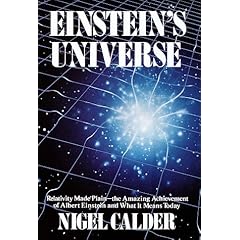
Einstein's Universe, Niger Calder


Einstein's Universe is an effort to capture the view of Einstein, particularly related to how he saw gravity, for the "common man."  The book has been favorably reviewed for years and I have a concern that it is rather dated.  The edition I am reading was published in 1979.  The book was intended to be a review of Einstein's theories on the 100th year of his birth.

Started: October, 2009
Completed: November 18, 2012
Recommended by:  Nobody, I picked this up at a library book sale
Recommendation:  Pick another physics book or get an edition that has been recently updated.
Review: 
As I expected, this book is generating some questions as I read it.  Right off the bat, there is a discussion of Doppler shift.  This discussion got me thinking about waves and what a wave is.  A wave is really just a special case of how matter is moving at any given time.  When you look at a wave on the ocean, you don't attribute the wave any properties that water doesn't already have.  The wave is sort of the look of the water.  So, if waves are something moving through matter, how do waves move through empty space?  I think they don't.  Surely this has bothered others since there is the wave/particle duality of light.

Speaking of wave/particle duality, I wonder of the pattern that shows up on the double slit experiment isn't caused by the light particles hitting and bouncing off of the insides of the slits (which must be zillions of times bigger then the light particle)?  I've wondered if the same results would occur if someone used a pitching machine to fire baseballs down a tunnel and into a board posted on the other side of the tunnel.  Would the interaction of the individual balls with the walls result in same kind of interference pattern seen in the double slit experiment?  I think it would, but I haven't done the math.  Something for another day.  Maybe these questions will make it to the other blog, "Old Curmudgeon Says."

I sure do like the way that the Nigel Carter explains why light should have weight.  It is counter-intuitive, but Mr. Carter is so clear and lucid in his explanation (quoting from Einstein as well) that it is obviously clear that light should have weight.

--so, some years later.  I have picked this book up and put it down so many times that it has frequently become lost.  As I have read more and more, I have found that it is increasingly out of date and (at least the version I'm reading) is misleading.  So, I have decided to stop reading it.