Showing posts with label Tad Williams. Show all posts

Friday, May 16, 2025

The Witchwood Crown, Tad Williams


The Witchwood Crown by Tad Williams is the first book  in the Last King of Osten Ard

Started: November 23, 2024
Completed: May 16, 2025
Recommendation: Highly recommended
Recommended By: Nobody, but I did read the first set of books in this series quite some time ago.  I have met the author at a book signing and brought all my copies of his books when I did meet him.  He was kind enough to sign them all and I really enjoyed talking with him.

Review:

It is with relief and a sense of homecoming that I have rejoined Osten Ard, once more in trouble and struggling to resolve issues likely beyond simple understanding.  As this book ended, I felt I was immediately ready to dive into the next!  It took me so long to read, however, as I had to take it out of the library several times in order to finish it and there were frequently long delays between holds.  It seems likely that I will need to purchase the next one.  I enjoy the richness of the races, the detail of this other world, and the growth and development of the characters.

Friday, April 1, 2016

The War of the Flowers, Tad Williams

 
The War of the Flowers by Tad Williams is a book about which I knew nothing when I bought it.  I had recently met Tad Williams at a book signing and had enjoyed his Memory, Sorrow, and Thorne series.  The dude is awesome.  Even his cat books.

Started:  2/17/2016
Completed: 5/23/2016
Recommendation: strongly recommended
Recommended By:  Nobody

Words for which I sought help:

chirurgeon -- archaic form of surgeon

dobber -- a person who secretly tells someone in authority that someone else has done something wrong.  It is also slang for male anatomy.

Review:

Early in the book is a simile that suggests hospitals are like T.S. Eliot poems.  I was not able to find a poem that embodied this imagery, but I did not look very hard. 

This book is truly an epic tale and a short review of a few paragraphs seems trite.  I like the general idea that magic has rules at that concept is explored in this book.   I also like the unwitting or anti-hero.  Finally, the idea of effectively the unstoppable force meeting the immovable object also peaks my interest.  This book has all that and the most delicious character, Applecore.  

Amongst concepts and imagry that frequently exceeds  imagination, the author exposes the gritty underbelly of Fairy in a journey to a place that is impossibly real with issues just as horrifying as those in the mortal realm.  

It is a good read with well crafted prose, some fantastic story lines, and a glimmer of hope for those who cannot imagine the hero within.

Sunday, December 12, 2010

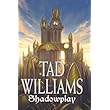
Shadowplay, Tad Williams

Shadowplay by Tad Williams is a sequal to Shadowmarch which I read fairly recently and I'm looking foward to reading this one!

Started: December 13, 2010
Completed: May 21, 2011
Recommendation:  Who could read this review and think that I would not highly recommend this book?
Recommended by:  I'm a Tad Williams junkie.  I found the copy of this book in South Carolina after I had checked and my "to read" pile was over 6 feet of books.  I swore, when I realized how much I had to read, that I wouldn't be buying more books.  Well, I bought this one.  And moved it to the top of the pile.

Words I looked up:


chirurgeon -- a surgeon usually in charge of first aid.
pentecount -- this is a made-up word, but probably means group of 50.

Review:


Wonderful, staggering, annoyingly not finished!  Throughout most of Shadowmarch the introduction of the various characters occurred.  A few more were introduced in Shadowplay.  Still the interaction of these characters is, for the most part, as ships passing in the night.  With deft touches the author mixes melodrama with high drama, the believable and the unbelievable, even a trip through a variant on Hades!  Consistently able to build a world of complex interaction, this series will undoubtedly lead to fascinating interactions.  How can I not yearn to read the next book?  I'm hopelessly connected to fictitious characters who loom large and small in their own stages and minds.  How many more times can Tad Williams bring major characters within a knife edge of death without actually killing them?  The few times that he has done so have been shocking and made the rest of the close encounters seem much more "real."  This master story-teller never ceases to drag me into an impossible universe with implausible characters who are viciously (and occasionally heart-stoppingly) real.

Friday, October 9, 2009

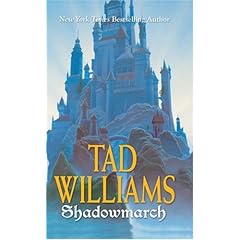
Shadowmarch, Tad Williams


Shadowmarch is the first in series of books (likely three?) in a new and rich world.  Tad Williams has historically developed a wealth of interesting characters inhabiting a  rich universe.  His books have interesting and complex plots and have often involved some sort of coming of age story intermixed with complex moral investigations.  The language is rich without being overwhelming (I haven't ever had to look up a word), but the first book is almost laborious to read in each of his series.  He tries to pack so much information into the beginning that the books are seriously plot dense and the plot lines rarely interact initially.  To the extent they do, they tend to confuse rather then enlighten.  I have very much enjoyed his other series and look forward to enjoying this one!

Started: January, 2009
Completed: November 22, 2009
Recommendation:  Good read for the patient reader who likes reading series books
Recommended By:  Nobody, I was wondering a Barnes and Noble while on vacation looking for some fun reading and picked up this book and a copy of Philosophy Now! magazine, to which I must subscribe at some point.
Review:  IT took about 400 pages to introduce the characters and establish a bunch of back story.  I enjoyed this because my experience has been that the richness of the introduction helps suspend disbelief and lays groundwork for interactions that are difficult to imagine being likely or even possible this early.  Clearly, this book does not stand on its own.  The end leaves all strings untied and virtually every character in some sort of turmoil.  There is one character, an immortal, who seems to have exactly the position she had planned with but the smallest wrinkle (therein, however, lies the groundwork for the future).  The protagonists are women in this story and that does seem a stretch.  Not being a woman, however, I have a feeling that I am much more forgiving of what must be obvious transgressions.  I like that there is not one characterization of a woman and that the book looks at many facets of women as different and distinct people (largely to the detriment of male characters who seem to fall smoothly into paranoid, conniving, honorable, or stupid with the occasional exception--most notably a "funderling" or dwarf in the more classical fantasy sense who defies such a simple explanation).

In most medieval fantasies men are the unquestioned masters of their domain and, while there is a strong sense of this superficially, it appears that, in this book, women have far more power then the traditional fantasy.  This occurs in several creative ways:  in royalty via death, in the common woman via sexuality, in the high-born via intrigue, in immortals via history, and, in one interesting case via intelligence.  The male characters encounter and, rarely defer to, women of high intelligence or cunning ripostes.  This is not to say that the men always get the worst of it, but there is no question that plenty of men do.

While the characters in the story are complex and fit broadly into the appropriate castes in medieval fantasy, there are a few that break the mold in interesting ways.  The sole female "funderling" we meet is shrewd and lovingly gruff while somehow finding an awkward balance with a stream of emotions that, it appears, she had sadly put aside prior to the opening of the book and now must fully address.  The court jester is not terribly funny and is very old--both odd characteristics for a jester.  The obligatory court fop is not particularly well dressed nor particularly eloquent (despite being a poet) although he feels he is both.  The smallest character in the book, "a rooftopper" (think borrower from the classic children's stories), has tremendous valor and resourcefulness.  This weird collection fits in grumpily with the stereotypes:  A cruel and all-powerful king, the girl who wants to be a warrior, the witch doctor/wizard who seems at risk for losing his fundamental values to pursue tremendous powers, the soldier who constantly fights with his duty, and the honorable warrior with an uncompromising commitment to his honor.  All in all, there remains a tremendous series of introductions to be had.and the plot has only begun.