Tuesday, April 5, 2011

The Most Human Human, Brian Christian

The Most Human Human by Brian Christian is a look at a classical test, the Turing Test, from the human side.  Plenty has been written about the computer side of the Turing Test, but this is a new book that addresses the uniquely human side.

Started:  3/23/2011
Completed: 6/19/2011
Recommendation: Recommended for programmers.  It is amazing how humbling it can be to "look" from the other side.
Recommended By:  I saw the author speak on John Stewart
Words I looked up:


anaphora -- repetition of a word or expression at the beginning of successive phrases, clauses, sentences, or verses especially for rhetorical or poetic effect 
asterism -- a group of three asterisks shaped into a triangle that are used in typography to denote subchapters in a book.
hegemony -- gaining control through consensus, not force.
ineffable -- too great or extreme to be described in words
pilcrow -- a typographic mark typically used to denote a paragraph, ""
palimpsest -- a manuscript page from a scroll or book from which the text has been scraped and which can be used again.
polysyndeton -- repetition of conjunctions in close succession
sanguine -- cheerfully optimisitc
stevedore -- a dock worker
trenchant -- vigorously effective and articulate
voided lozenge -- A symbol in heraldry (also called a "mascle") that is a diamond within a diamond.

Review:  


When a journalist looks at computer interfaces, there is something to learn.  Having read this book in concert with listening to Moonwalking with Einstein it is interesting to me that these two books which each try to reach into the essence of humanity from different angles share so much in common.  Neither is a repeat of the other, but the overlaps are significant.  There is more to human interaction then simple communication--there is a certain degree of binding that occurs when two people talk well and it cannot be approximated well by computers who are simply mimicking what has been put into them (albeit quite well).  At the same time, the vast store of sheer information stored by computers can be approximated through the human mind with a little effort and that allows for a structure in which to hold not only a good discussion but even more information.

At some points, Brian Christian suggests that the novelty of a good conversation lies in its surprise and Joshua Fore suggests that one of the most engaging uses of memory is being able to create novel links between seemingly disparate sources.  It seems to me (making a novel link :) ) that effective use of memory facilitates good conversation.  Brian Christian talks about leaving footholds for conversation by leaving many open-ended references and Joshua Fore points out that having established memory points lets us view information within a context that takes us beyond rote knowledge or parlor tricks into a deeper understanding of the world around us.  It may just be me, but it seems like these two different books (both by journalists about competitions) are particularly in tune with one-another and should be read together for maximum gain.

To the heart of being the most human human, Mr. Christian found it anti-climactic as one might expect.  Being acknowledged for what one is is rarely as interesting as becoming something more then one is.  The journey, however, that brought him to that point is well worth the read and is a good overview into the shortcomings of a "heartless" interaction that characterizes current AI systems that purport to interface with us.  As companies have developed increasingly complicated systems to try to address anticipated customer needs, the flexibility and creativity of a real human being has never been more in evidence.  These elaborate efforts are fairly good at handling simple items (phone trees work reasonably well for movie theaters until the theaters forget that the phone tree is intended to drive people to the movies and start inserting advertising that is far less effective), but if you have ever tried to call a bank and do something relatively unusual (like stop payment on a check) the phone tree feels impenetrable as it both fails to handle the need and obscures the process for getting to a real human (which is where the phone tree ends up if one happens to find the right path).

As a programmer, the intuition and research that Mr. Christian offers in his book is important and something to be considered in developing a system that interacts with people.  I think that one thing programmers largely have in common is an inability to interact well themselves and so it is no surprise that the applications generated by this social inept group should themselves be socially inept.  Some of the information offered by Mr. Christian may help programmers become more socially skilled and, by extension, facilitate the growth of socially skilled applications.  Physician, heal thyself.

Saturday, April 2, 2011

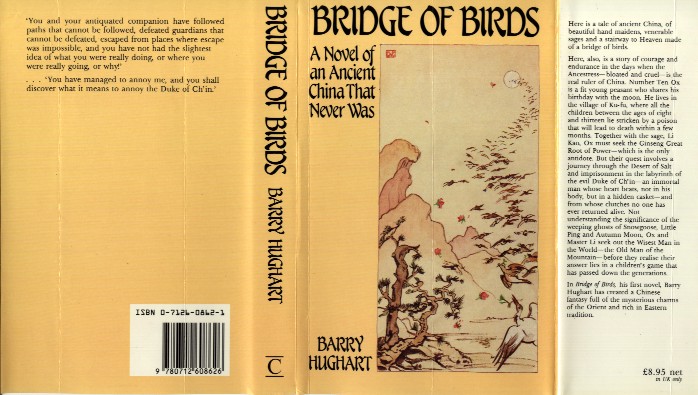
Bridge of Birds, Barry Hughart

Bridge of Birds by Barry Hughart is written in the style of ancient Chinese literature.  It is an imaginary story that takes place in an imaginary China circa 600.  I've had this book on my reading list for 15 years and finally got a copy.

Started:  3/26/2011
Completed: 4/4/2011
Recommendation: EXCELLENT, fun, read!
Recommended By:  I think I read about this book in the Washington Post Book Review
Words I looked up:


bonze -- a Buddhist priest in Japan

Review:  What a fun book!  From references like a story that one of the characters gives of his life that beings with:  "It was a dark and stormy night..."  There is clear humor and there is subtle humor and there is the humor that you get three pages later.  This is the kind of book where you have to share a passage with someone else!  If you read only one book in 15 years, this would not be it, but if you need a good beach read or you want an exciting chuckle (it is an adventure novel) then run out to a used book store (it is out of print) and grab a copy.  You will not regret it.

Sunday, February 13, 2011

Empire of Liberty, Gordon S. Wood


Empire of Liberty by Gordon S. Wood is the second in the series The Oxford History of the United States which, oddly, seems to be a very good place to get the history of the US.  I'm reading this book to try and get some material together to teach history to my 5th grade son.

Started: 2/13/2010
Completed:
Recommendation:
Recommended By: A Major at the Pentagon who got to talking with my wife while I took my son on a tour of the Pentagon.
Words I Looked Up:


ancien -- a system or mode no longer prevailing
entablature -- a horizontal, continuous lintel on a classical building supported by columns or a wall, comprising the architrave, frieze, and cornice
labile -- unstable, quick and ready to change
mezzotinto -- a form of intaglio etching in which a metal plate is roughened and then smoothed to bring out an image.(It seems that this word was used to mean fine engraving with a delicate touch.  In the book it was contrasted with an elephant.)
peripatetic -- travelling from place to place, especially working or based in various places for short periods
trenchant -- having keenness and forcefulness and penetration in thought, expression, or intellect
tympanum -- a vertical recessed triangular space forming the center of a pediment, typically decorated


Review:  Will write one when I'm done.

Thursday, January 20, 2011

Jupiter, Ben Bova


Jupiter by Ben Bova is a book written in a series called "The Grand Tour" which has a book for each planet (and some asteroids).  I like the way that Ben Bova takes some science and mixes it with some "extensions" to come up with a really interesting twists for his novels.  By "twists" I mean moral dilemmas, not surprise endings.

Started: 1/19/2011
Completed: 1/27/2011
Recommendation: Gotta be a hard core SF fan to enjoy it
Recommended By: Nobody, I like Ben Bova's stuff and saw this at a yard sale


Review:


This is a book for the hardcore SF reader.  Lots of stuff is assumed, plasma drives, AI, nanotechnology, etc.  If these terms aren't familiar to you, well, the book uses them but doesn't explain them.  There are also several instances of wild hand waving that will frustrate anyone with a science background (aerodynamics seem to be largely ignored though frequently referenced, "scoop ships" get many references but seem to defy any sort of description, and while it is possible to reline with ceramic a running engine nozzle, there is virtually no form of healthcare for the crew anywhere).  The topics evaluated are very broad (if Radar from M*A*S*H was on a space station around Jupiter, what would he do?)  and range from the ethical to religious and off to scientific rather seamlessly.  Some of the science can be jarring (walls for video, but floors that display images are unusual) but the parts that are clearly speculative are treated that way in the novel and the questions that any one of us might ask are briefly addressed (what would it "feel" like if neurons were connected directly to feedback from an engine that was giving out?).  In general, I liked the book.  It was a compelling read, had simple and easy to understand characters.  It is basically a beach book and I'm looking forward to reading the sequel.

Sunday, December 12, 2010

Shadowplay, Tad Williams

Shadowplay by Tad Williams is a sequal to Shadowmarch which I read fairly recently and I'm looking foward to reading this one!

Started: December 13, 2010
Completed: May 21, 2011
Recommendation:  Who could read this review and think that I would not highly recommend this book?
Recommended by:  I'm a Tad Williams junkie.  I found the copy of this book in South Carolina after I had checked and my "to read" pile was over 6 feet of books.  I swore, when I realized how much I had to read, that I wouldn't be buying more books.  Well, I bought this one.  And moved it to the top of the pile.

Words I looked up:


chirurgeon -- a surgeon usually in charge of first aid.
pentecount -- this is a made-up word, but probably means group of 50.

Review:


Wonderful, staggering, annoyingly not finished!  Throughout most of Shadowmarch the introduction of the various characters occurred.  A few more were introduced in Shadowplay.  Still the interaction of these characters is, for the most part, as ships passing in the night.  With deft touches the author mixes melodrama with high drama, the believable and the unbelievable, even a trip through a variant on Hades!  Consistently able to build a world of complex interaction, this series will undoubtedly lead to fascinating interactions.  How can I not yearn to read the next book?  I'm hopelessly connected to fictitious characters who loom large and small in their own stages and minds.  How many more times can Tad Williams bring major characters within a knife edge of death without actually killing them?  The few times that he has done so have been shocking and made the rest of the close encounters seem much more "real."  This master story-teller never ceases to drag me into an impossible universe with implausible characters who are viciously (and occasionally heart-stoppingly) real.

Parliament: Canada's Democracy and How it Works, Maureen McTeer


Parliament by Maureen McTeer is a non-fiction account of how Canadian Parliament works.

Started:  December 13, 2010
Completed: May 22, 2011
Recommendation: Excellent as a Primer
Recommended By:  Several years ago I was in Canada and stopped by a library that happened to have a book sale.  This was one of the books in that sale that caught my interest.

Review:


This is a children's book and, as such, explains terms that an adult book would take for granted.  This is a swift overview of the basics of the system while only addressing the broad details of government history.  This is an easy read, I'd have finished in a day if I hadn't lost it amongst some other things.

The Apprentice, Paulo Coelho


The Alchemist by Paulo Coelho is a modern allegory offering a story to describe how people should live their lives.

Started:  December 10, 2010
Completed:  December 13, 2010
Recommendation: Not recommended
Recommended by:  My neighbors read it and thought the beginning was good but it fizzled.

Review:  Sort of a "The Secret" meets "The Celestine Prophecy" kind of book.  I'm not buying that the universe wants me to meet my goals and will work on my behalf.