Sunday, May 22, 2011

Neverwhere, Neil Gaiman

Neverwhere by Neil Gaiman is a book I picked up when Vertigo was closing.  I really enjoyed American Gods and Anansi Boys.  I saw this book before I had read Anansi Boys, but it caught my eye because of the advertising for American Gods that was on the cover.  I choose to read this book now with a little trepidation, because I have since learned that Gaiman started out writing horror and that is not a subject matter I particularly enjoy.

Started: June 4, 2011
Completed: June 4, 2011
Recommendation: Highly recommended
Recommended By:  I saw this on the shelves as Vertigo was closing.

Review:


Yeah, I read this book in one day.  Start to finish.  That was not the plan.  I had a lot to do.  The stars aligned, however, and I got time to read combined with a book that made turning the page not just a way to move the story forward but a hungry demand.  There is no "good place to stop" in this book.  The writing is engrossing, the plot and sub-plots are clever, the characters are compelling, and the author's ability to engross the reader is engaging.  As I sat in the dead of night with my book light illuminating the final pages, I experienced the deliciousness of the stolen moments from my childhood when a book drew me under the covers with a flashlight.  So, I liked it.

Who should read it?  Well, those who like a clever turn of phrase, "There were four ways for the astute observer to tell them apart [4 very distinct descriptions are given]....in addition, they looked nothing alike," will likely walk away from this book satisfied that the author has leveraged his craft.  Those who would like to believe that there is no such thing as a chance encounter or a sound in the night that is not caused by some unseen and potentially malicious "thing" that could only be properly removed from the world by deft knife work will not go unsatisfied.  A geek, nerd, klutz,  or other everyday person who knows in his heart that under the right circumstances, with just a little persuasion from an indifferent universe and a troop of friends who really want to help each other any obstacle can be overcome by reaching deep down inside themselves to become something they truly are not will find in this story a parallel.  Yes, Dungeons and Dragons fans, here is the "real life" nitty gritty embodiment of your obsession without the need to go to magic or creatures that live so far from reality that one might look back to find the bridge to the real world obscured by rolling hills.

The hero of this story is so nondescript that you never find out what he looks like.  The few descriptions that appear are so distorted by circumstance as to represent the situation more than the individual.  You know that he doesn't think much of himself and the world around him agrees.  He is not very good at living and his only outspoken trait is a mild compunction for those who are homeless.  This sole characteristic, however, drives the story forward and his own ineptitude--his willingness to be swept along by events rather then to craft a life of his own--draws him via one swirling eddy into a new world where he learns to live his life because death is around every corner and drifting is tantamount to suicide.  It is a delicious joy to see this person who struggles to exist become Someone.

There is a certain sickness to readers who become engrossed in this type of story.  It is a sadness about one's own sense of one's self, one's life, and the hope that if things were just "different" one might shine.  The characters in this book, for the most part, do not understand one another, are not compassionate towards each other, and betray one another with a nonchalance that is oddly breathtaking.  The small, fleeting moments when one character reaches out to another directly (the poor comfort offered Door as she returns to her home where her family has been murdered and Richard's compassion for the rat-speaker--examples that don't ruin the story) are sufficient to humanize an inhumane environment.  The social ineptitude of the cast of characters on all levels reflects the social skills of the engrossed reader and imply that the failings of the reader himself may, in some odd way, be an advantage.

So, if you read this book and like it then you are sick.  Your sickness does not coat your life with a stench that well-meaning people cannot help but avoid.  It does, however, leave you on the fringes of society looking in and aching for the teeming acceptance that the others seem to enjoy.  This book also suggests that the acceptance is as illusory as Springsteen's "Glory Days" and the way to feed your hunger is to go live your life rather then stare from the backwaters.  In this way, this book is a self-help tome for those who have this sickness.  The question is, do you have to pick up a bleeding woman from the street to go find your life?

Monday, April 25, 2011

46 Pages, Scott Liell

46 Pages:  Thomas Paine, Common Sense, and the Turning Point to American Independence by Scott Liell contains the entire text of the Common Sense and includes commentary to help explain it.  Concise and well-written, Liell's commentary is said to be a "must have."  My wife and I both have an interest in this book, so she reads it to me while we are driving on long trips.

Started: 4/18/2011
Completed: 6/2011
Recommendation: Strongly Recommended
Recommended by:  I saw this book at Vertigo when it closed and it called out to me.  Common Sense is something I've always felt I should read.  This book was also selected by the family for a book discussion this summer.
Words I looked up:


encomium -- A speech or piece of writing that praises someone or something highly.
jesuitically -- basically means "like a Jesuit," but that isn't helpful.  Describing someone as a Jesuit (who is not a Jesuit) is to say that person is "given to subtle casuistry."  Casuistry is excessively subtle reasoning intended to rationalize or mislead.
papistical -- of or relating to or supporting Roman Catholicism

Review:  Common Sense is funny and Liell helps give the context necessary to understand the humor.  The back story of Thomas Paine is interesting as well.  This is a fantastic discussion of one of the most important books in the American Revolution.  Just wonderful.

Sunday, April 17, 2011

Memoirs of Pontius Pilate, James R. Mills

Memoirs of Pontius Pilate by James R. Mills is a novelization of Ponitus Pilate's thoughts on Jesus of Nazereth written by a politician.


Started: 4/16/2011
Completed: 4/17/2011
Recommendation: eh, unlikely to be worth your time unless you haven't read the Gospels
Recommended by:  An extended family vacation led to the creation of a book discussion group and this was the #3 book voted upon by family members for us all to read.
Words I looked up:


obstreperous -- resisting control or constraint in a difficult manner; unruly


Review:  Well, sadly this book was annoying.  It was supposed to be a politician's view of Pilate's perspective. Instead, Pilate plays idiot savant to Mills recounting of the Gospels.  There were  a couple of errors that really rubbed me the wrong way and one blatant effort to forward the author's own political position.  This book didn't feel like a novelization of Pilate's Memoirs, it felt more like a novelization written in the hollow voice of a flawed character that was neither investigated nor developed.  One might have expected something about Pilate's childhood, but you hear about Jesus' childhood.  One might have expected a ton of issues that had nothing to do with Jesus of Nazareth, yet the entirety of the book revolved around the dubious "questioning" position of Pilate who, by turns, disregards and upholds the beliefs of both Jews and Christians.


One shocking thing is that the author used Pilate's wife as a plot foil, but failed to address her death at all; a topic that was clearly of very high importance to the Pilate developed by the author.  IMNSHO, this book was poorly written.  I have no understanding at all how it made it onto the top 100 list of historical novels forget #2.  The only list this would make for me is "Approachable Restatings of the Bible."  I'd care to add that while this book might make such a list, it would be so completely buried by virtually every other book on that list as to be unfindable.  Ugh.

Thursday, April 14, 2011

The Feud, Thomas Berger

The Feud by Thomas Berger is a comedy written by the same man who gave us "Little Big Man."  This book looks at two feuding towns in 1930s America.  This book was nominated for a Pulitzer Prize.

Started:  4/14/2011
Completed:  4/28/2011
Recommendation:  It is difficult to recommend this book.  It isn't fun.  It is close to truth.  Close to painful truth.
Recommended By:  An extended family vacation led to the creation of a book discussion group and this was the #1 book voted upon by family members for us all to read.
Review: So what to say about this book?  This is the mountain out of a mole hill writ hick.  So a minor disagreement and a line of constantly topping intolerance leads to a modern comedy of errors.  The middle of the book is a mild twist in so far as simple character flaws start becoming serious downfalls.  Characters start taking a beating...individuals start falling apart in every way imaginable.  Some new characters who, themselves, represent the fulfillment of poor decisions appear, splatter, and slip from the pages.

The book does not end with a belly laugh, a chuckle, or even a wry grin.  It is as harsh, greasy, and oddly, stale and sweet as the crumbs in the bottom of an empty bag of donuts.  Like the bag is empty, sadly the story is as well.  While you've learned about these people and, in some ways, started to sympathize with them, in virtually every case they are repugnant at a base level.  I didn't come away from this book wondering what happened to them or with any desire to hear more of their sordid lives.  I had a very hard time laughing at the ridiculous behavior after the consequences turned so dire.  Perhaps that is a good thing.

The Feud is edgy.  Not the way "edgy" is viewed today.  It is not raunchy.  It is not foul.  The Feud looks at people as they horribly are.  It unashamedly offers up the devastating consequences of our own flaws drawn out upon the stage of destitute poverty,  The consequences of small flaws--big sins--are even worse when put under the vise of financial stress.

I'm not convinced you learn anything by reading this book.  It is mildly entertaining and unabashedly forthright, but it uses the comedic tool of drawing everything to extremes--the sheriffs don't disagree, they actively wish to hurt one another; the sex abusers aren't ashamed of themselves; the self-interest knows no bounds; and the doormats stand before cavernous spaces.  Since everything is so extreme it is impossible to view the book in anything but the harsh black and white light that bursts from caricature.  It feels like the humor can only be enjoyed by those how titter uncontrollably as the three year old throws a baseball into his father's scrotum.  The humor seems painfully reminiscent of a Peeping Tom's look at squalid indignity.

Of course, the worst part is that I'm writing this two days after the rest of the review.  Maybe the quality of this book shows in that I'm still stewing about it.  Maybe I felt like a Peeping Tom because the author had taken the trouble of making these comically distorted characters seem real.  I'm still mad at some for their behavior, sorry about the sad situation for others, and worried for the poor decisions that characterized them all.  No, I don't want to read more about them, I'd just as soon forget them.  But somewhere, somehow, the author has managed to make them "real" enough to have woven themselves into my thoughts occasionally bumping against real people with real problems.  And that, my dear reader, may be why this book was nominated for a Pulitzer.  Still and all, it is annoying.

Tuesday, April 5, 2011

The Most Human Human, Brian Christian

The Most Human Human by Brian Christian is a look at a classical test, the Turing Test, from the human side.  Plenty has been written about the computer side of the Turing Test, but this is a new book that addresses the uniquely human side.

Started:  3/23/2011
Completed: 6/19/2011
Recommendation: Recommended for programmers.  It is amazing how humbling it can be to "look" from the other side.
Recommended By:  I saw the author speak on John Stewart
Words I looked up:


anaphora -- repetition of a word or expression at the beginning of successive phrases, clauses, sentences, or verses especially for rhetorical or poetic effect 
asterism -- a group of three asterisks shaped into a triangle that are used in typography to denote subchapters in a book.
hegemony -- gaining control through consensus, not force.
ineffable -- too great or extreme to be described in words
pilcrow -- a typographic mark typically used to denote a paragraph, ""
palimpsest -- a manuscript page from a scroll or book from which the text has been scraped and which can be used again.
polysyndeton -- repetition of conjunctions in close succession
sanguine -- cheerfully optimisitc
stevedore -- a dock worker
trenchant -- vigorously effective and articulate
voided lozenge -- A symbol in heraldry (also called a "mascle") that is a diamond within a diamond.

Review:  


When a journalist looks at computer interfaces, there is something to learn.  Having read this book in concert with listening to Moonwalking with Einstein it is interesting to me that these two books which each try to reach into the essence of humanity from different angles share so much in common.  Neither is a repeat of the other, but the overlaps are significant.  There is more to human interaction then simple communication--there is a certain degree of binding that occurs when two people talk well and it cannot be approximated well by computers who are simply mimicking what has been put into them (albeit quite well).  At the same time, the vast store of sheer information stored by computers can be approximated through the human mind with a little effort and that allows for a structure in which to hold not only a good discussion but even more information.

At some points, Brian Christian suggests that the novelty of a good conversation lies in its surprise and Joshua Fore suggests that one of the most engaging uses of memory is being able to create novel links between seemingly disparate sources.  It seems to me (making a novel link :) ) that effective use of memory facilitates good conversation.  Brian Christian talks about leaving footholds for conversation by leaving many open-ended references and Joshua Fore points out that having established memory points lets us view information within a context that takes us beyond rote knowledge or parlor tricks into a deeper understanding of the world around us.  It may just be me, but it seems like these two different books (both by journalists about competitions) are particularly in tune with one-another and should be read together for maximum gain.

To the heart of being the most human human, Mr. Christian found it anti-climactic as one might expect.  Being acknowledged for what one is is rarely as interesting as becoming something more then one is.  The journey, however, that brought him to that point is well worth the read and is a good overview into the shortcomings of a "heartless" interaction that characterizes current AI systems that purport to interface with us.  As companies have developed increasingly complicated systems to try to address anticipated customer needs, the flexibility and creativity of a real human being has never been more in evidence.  These elaborate efforts are fairly good at handling simple items (phone trees work reasonably well for movie theaters until the theaters forget that the phone tree is intended to drive people to the movies and start inserting advertising that is far less effective), but if you have ever tried to call a bank and do something relatively unusual (like stop payment on a check) the phone tree feels impenetrable as it both fails to handle the need and obscures the process for getting to a real human (which is where the phone tree ends up if one happens to find the right path).

As a programmer, the intuition and research that Mr. Christian offers in his book is important and something to be considered in developing a system that interacts with people.  I think that one thing programmers largely have in common is an inability to interact well themselves and so it is no surprise that the applications generated by this social inept group should themselves be socially inept.  Some of the information offered by Mr. Christian may help programmers become more socially skilled and, by extension, facilitate the growth of socially skilled applications.  Physician, heal thyself.

Saturday, April 2, 2011

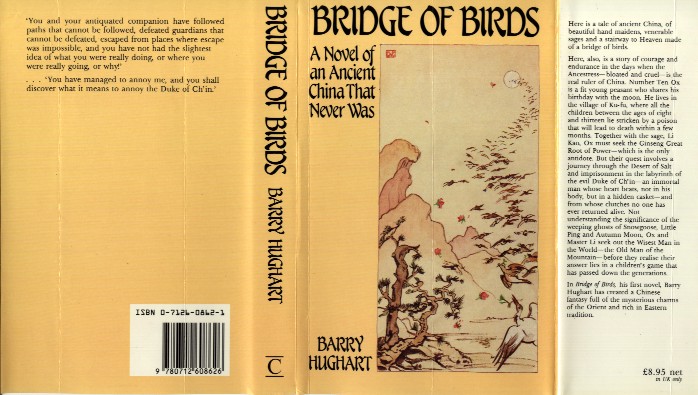
Bridge of Birds, Barry Hughart

Bridge of Birds by Barry Hughart is written in the style of ancient Chinese literature.  It is an imaginary story that takes place in an imaginary China circa 600.  I've had this book on my reading list for 15 years and finally got a copy.

Started:  3/26/2011
Completed: 4/4/2011
Recommendation: EXCELLENT, fun, read!
Recommended By:  I think I read about this book in the Washington Post Book Review
Words I looked up:


bonze -- a Buddhist priest in Japan

Review:  What a fun book!  From references like a story that one of the characters gives of his life that beings with:  "It was a dark and stormy night..."  There is clear humor and there is subtle humor and there is the humor that you get three pages later.  This is the kind of book where you have to share a passage with someone else!  If you read only one book in 15 years, this would not be it, but if you need a good beach read or you want an exciting chuckle (it is an adventure novel) then run out to a used book store (it is out of print) and grab a copy.  You will not regret it.

Sunday, February 13, 2011

Empire of Liberty, Gordon S. Wood


Empire of Liberty by Gordon S. Wood is the second in the series The Oxford History of the United States which, oddly, seems to be a very good place to get the history of the US.  I'm reading this book to try and get some material together to teach history to my 5th grade son.

Started: 2/13/2010
Completed:
Recommendation:
Recommended By: A Major at the Pentagon who got to talking with my wife while I took my son on a tour of the Pentagon.
Words I Looked Up:


ancien -- a system or mode no longer prevailing
entablature -- a horizontal, continuous lintel on a classical building supported by columns or a wall, comprising the architrave, frieze, and cornice
labile -- unstable, quick and ready to change
mezzotinto -- a form of intaglio etching in which a metal plate is roughened and then smoothed to bring out an image.(It seems that this word was used to mean fine engraving with a delicate touch.  In the book it was contrasted with an elephant.)
peripatetic -- travelling from place to place, especially working or based in various places for short periods
trenchant -- having keenness and forcefulness and penetration in thought, expression, or intellect
tympanum -- a vertical recessed triangular space forming the center of a pediment, typically decorated


Review:  Will write one when I'm done.