Monday, September 3, 2012

Sword Song, Bernard Cornwell

Sword Song by Bernard Cornwell is the fourth book in the Saxon Stories.

Started: 6/20/2012
Completed: 7/27/2012
Recommendation: Oh, yeah, still enjoying this series!
Recommended By: Nobody

Review:

The story of Uhtred continues with a foray into London.  During this book it is easy to see the skills of leadership being developed (through both success and failure).  Despite the title, it seems to me that in this book Uhtred starts to find that war is not all its cracked up to be and though he still participates with relish, it seems that the character is slowly growing tired of the mayhem.  He is, however, a fierce Lord who seems to relish in the argument that, "a man is hard to kill."

The Lords of the North, Bernard Cornwell

The Lords of the North by Bernard Cornwell is the third novel in the Saxon Stories.  This story follows Uhtred's trip to the North as Uhtred, having served Alfred well, looks for an opportunity to return home.

Started: 5/20/2012
Completed: 6/16/2012
Recommendation:  Still hooked by this series
Recommended By: Nobody

Review:

In this book, we get some of the "action tension" that a romantic comedy uses as "romantic tension."  There is action and it seems to be constant.  It is clear by this book that Uhtred is going to get in a scrape and come out victorious.  This is the first book, however, in which Uhtred really takes a hard loss from his action and it is a harbinger of things to come.  This book mostly seems to set the stage for some future work where the events of this book were critical to some future plot twist.  With little surprise, the plot in this book moves as expected with one surprising (though constantly foretold) event.  I don't want to give away the plot, but it did throw me.

I did not realize that there were several audio version of this book and leaving Jamie Glover (I think to listen to Richard Armitage) hurt the book in my ears.  The phrase "Uhtred of Bebbinburg" no longer had the ring of longing associated with it.  The names of characters and places were pronounced differently and it took a little bit of a recovery to once more suspend my disbelief.

The Pale Horseman, Bernard Cornwell

The Pale Horseman by Bernard Cornwell is the second in the Saxon Stories and picks up after the last kingdom.  I couldn't wait to hear more about Uhtred.

Started: 4/26/2012
Completed: 5/11/2012
Recommendation:  Loved it!
Recommended By:  Nobody

Review:

The story of Uhtred continues in this gripping saga of England under Danish control.  Uhtred becomes more human and parts of his character are fleshed out in this book.  To show that Uhtred is not a one shot wonder, he goes on to take a prominent role in helping Alfred restore the kingdom of Wessex from under Danish control and lays the foundation for the concept that Uhtred could actually be a leader himself one day.  The battles continue and this story will not disappoint anyone looking for action scenes.  While it seems that time spent in a swamp simply can't have much action beyond a lost boot, Bernard Cornwell handles it well. 

Wired Love, Ella Cheever Thayer

Wired Love:  A Romance of Dots and Dashes by Ella Cheever Thayer was a Project Gutenberg book that caught my eye.

Started: 10/19/2011
Completed:  5/10/2012
Recommendation:  Not recommended
Recommended By:  I read a magazine article about love via email while doing some research on one of my son's efforts to find a Russian bride.  It mentioned this book as the first description of remote romance, so I thought I'd give it a try.

Words I looked up:

inamorata - A person's female lover

Review:

This is a book that is typical of pulp fiction at the time.  It isn't quite as dramatic as there are only one or two fainting scenes and there aren't any conversions to God.  It has the mild air of a comedy (mistaken identities and such) but one poorly drawn as I never found myself laughing out lout and the mistaken identities seemed to be generally painful to the characters.  The romance via Morse Code is definitely over played though it seems to have been semi-auto biographical.  The constant "restraint" exercised by the characters literally overshadows their ability to interact in almost any way and the book dissolves to some kind of constant cat and mouse played by characters who seem to always do the wrong thing for questionable reasons.

Thursday, April 26, 2012

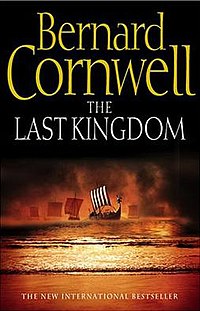
The Last Kingdom, Bernard Cornwell

The Last Kingdom by Bernard Cornwell is a book that I picked up to hear during my commute.  I was browsing the CDs in the library and saw his most recent in this series.  This book, the first, was not on the shelves so I ordered it and listened.

Started:  3/1/2012
Completed:  4/22/2012
Recommendation:  Loved it!  The audio version is awesome and the actor who does the reading takes me to a whole other level.
Recommended by:  Nobody
Review:


This first book in a substantial series follows the life of an English Lord from his earliest years as a prisoner of the Danes through his first major battle as an Englishman.  The cadence and pace of the story has a visceral quality that, when combined with the unflinching description of the times, brings the reader to a new place in an old time.  The stench of unwashed bodies follows each scene and the horror of hand-to-hand combat leaps from the page.  The romance that is present (it is rare) is not gushy, but has more of a hard edge to it and throughout the book in any circumstance, we don't live every moment as the first person narrative might.  There is a certain distance that is maintained with an occasional glimmer of the person inside the narrator in both predictable and unpredictable ways.

If you can get past all the death (and there is plenty of it) the book has a certain desperate liveliness to it.  There is a hunger for life that helps carry the imagination and the little details that the author has added from scraps of actual history help build a scaffolding for the story that makes it believable.  This is no sword-and-sorcery tale, more of a fleshing out of a nasty story that could possibly have been (but certainly wasn't).  The hard-edge story telling reminds me of Morgan Llewellyn.

Monday, March 19, 2012

Alexandria, Lindsey Davis

Alexandria by Lindsey Davis is a Marcus Didius Falco novel.  Part of a series of novels about an informer in the court of Vespasian.

Started:  1/10/2012
Completed:  2/15/2012
Recommendation:  If you are only going to read one historical novel about a Roman investigator I prefer the Roma Sub Rosa series by Steven Saylor.
Recommended By:  A librarian at the local library
Review:


As a mystery this book fails.   There are a series of deaths and a series of clues, but it is simply impossible to solve the "mystery" with the information given in the book before the detective, Marcus Didius Falco, does.  In fact, it seems that he stumbles on the solution just as the rest of us do.

As a character study, this book fails.  The protagonist is not terribly interesting (this is the 19th in a series of books, so his character is probably as well developed as it is going to get).  His wife, Justina, is equally undeveloped.  The potential here is to develop the uncle, but that character is wildly neglected and serves largely as a mildly sinister foil to the good nephew.

Alexandria is an interesting city, but it is used as a backdrop and the library itself is used as a cavity into which the story is placed.  There is the occasional step into historical information (I guess), but nothing that caught my attention.  The zoo that was associated with the library was interesting, but so little was told of the nature of it that the simple fact of its existence was all I was able to garner.  Perhaps the source material is lacking.

In short, if you are not a fan of Marcus Didius Falco already, this book should not compel you to read more.  If you are a fan, then I don't know whether this book is consistent with the series or an aberration.


Leonardo, Michael White

Leonardo: The First Scientist by Michael White is a biography of Leonardo da Vinci that makes the argument that he is not only an artist and architect, but also a scientist.  The claim that he was the first scientist is loose.

Started:  2/15/2012
Completed: 3/18/2012
Recommendation: A good read, even a good first introduction
Recommended by:  Nobody, I just needed a book to listen to during the commute.
Review:


I have a special interest in Leonardo largely because of his interest in flight.  I loved his study of birds and it wasn't until I started studying how patterns of flight for flocks of birds for computer science that I learned he had even contributed to the study of birds.  I have long been fascinated by his inventions.  This book gave me good background on his life and it was interesting to examine how a pacifist vegetarian became the creator of war engines.

The argument that Leonardo was the first scientist is really not made.  He is not truly compared to others before him who might have been considered scientists except in the most general way.  In fact, comments on his predecessors really did not address the possibility  that they may be considered scientists at all. The author focuses on the argument that Leonardo should be considered a scientist.  The broad argument goes that despite the "scientific method" being devised long after Leonardo's death, Leonardo showed enough of what we consider the "scientific method" that his practices fit the description though they predate the actual definition.  Leonardo's scientific work was also never really published (certainly not in his lifetime), so some considerable time is spent explaining why it was not and how this is largely not Leonardo's fault.  It seems likely to me that the argument of his being a scientist in some way also hinges on the publication of his work.

From a practical point of view, the argument over whether he was or was not technically a "scientist" is overshadowed by his amazing work.  The author does a good job of helping us understand Leonardo and his work culturally and in terms of its potential scientific value.